
Transit Shipping via the Northern Sea Route in 2025 – Key Figures of the Season
The 2025 summer–autumn transit season along the Northern Sea Route (NSR) has officially concluded. Navigation lasted from June 30 to November 17, enabling international transit for nearly four and a half months. The season's results indicate stable shipping activity and moderate growth compared to the previous year.
Navigation Periods and Shipping Activity on the NSR
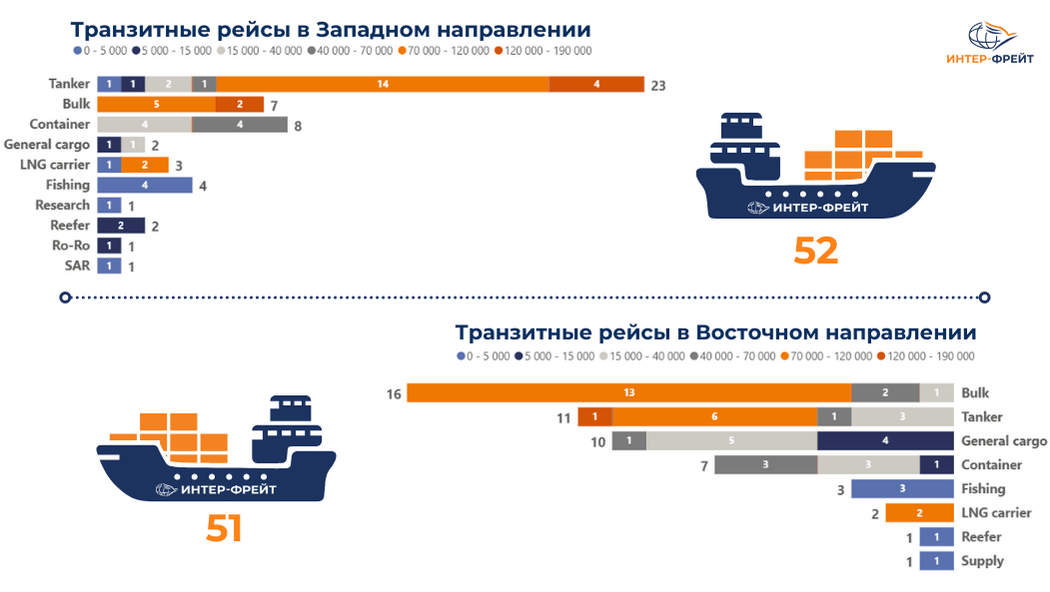
As of November 30, 2025, a total of 103 transit voyages were recorded, carried out by 88 unique vessels. The report accounts for voyages that crossed the entire route without calling at ports within the NSR. Of these, 52 were eastbound and 51 westbound.
Official cargo volume data will be published later by Rosatom, but preliminary estimates indicate that the total transit cargo volume for the 2025 season reached approximately 3.2 million tonnes.
Transit Fleet Structure
Shipping activity was distributed as follows:
Tankers remained the largest category by number of voyages, with a total of 34 transits, including 23 eastbound and 11 westbound.
Bulk carriers saw increased activity: 23 voyages (7 eastbound, 16 westbound), significantly higher than last year.
Container ships completed 15 transits, showing growth compared to the previous season.
General cargo vessels carried out 12 voyages, while LNG tankers made 5 transits.
Additional voyages were made by auxiliary vessels, including fishing, refrigerated, research, supply, and Ro-Ro ships.
Trend Dynamics
Compared to 2024:
the number of transit voyages increased by approximately 6.2%,
cargo volume grew by around 3.2%,
and the fleet’s total deadweight tonnage showed moderate growth to ≈6.23 million tonnes.
Activity increases were especially noticeable in the bulk carrier and container ship segments, while the number of tanker voyages slightly declined compared to last season.
The NSR as an Alternative Logistics Route
In 2025, the NSR continued to attract attention as an alternative to traditional Asia–Europe routes. The rise in both westbound and eastbound transits shows that the route is actively used not only for raw material exports but also for commercial shipments.
Experts emphasize that further development of navigation will depend on factors such as ice conditions, availability of icebreaker escort services, and the level of logistics infrastructure along the route.
Season Conclusions
The 2025 navigation season demonstrated that transit via the Northern Sea Route maintains a positive trend, albeit without sharp spikes. Moderate growth in the number of voyages and cargo volumes indicates gradual market adaptation to the Arctic route and its specific conditions.
For shippers and logistics operators, the NSR remains a niche but promising direction, capable of complementing traditional maritime routes when transit planning is carefully managed.
Inter-Freight LLC also actively uses the Northern Sea Route in its operations, managing transit shipments and preparing for the next navigation season.
- Request a Call
- Contact by phone+375 (29) 641-97-27
- Send an email:contact@inter-freight.by
-
 05 апреля 2024Car delivery to Belarus via IstanbulCurrently, there is a ban on the import of luxury cars entering Belarus through Poland and Lithuania.Read
 -
 11 июня 2025Inter-freight Receives FIATA Certificate – Confirmation of High Logistics StandardsInter-freight is now an official FIATA member. The certification confirms compliance with global logistics standards and opens new opportunities for international freight forwarding.Read
 -
 27 мая 2025The Inter-freight employees conquered the «Naliboki-2025» cycling marathon — a challenge of rain and true teamwork.The InterFreight team completed the «Naliboki-2025» cycling marathon through rain and mud, proving the strength of their corporate spirit. The employees supported each other on the challenging course, demonstrating the company’s core values.Read


